Have you noticed how many AI projects begin with excitement… and then quietly fail to go anywhere?
I'm seeing that a lot.
A demo here, a pilot there, plenty of internal discussion, but very little that actually becomes part of day-to-day operations.
And it's not because AI doesn't work or doesn't offer value. In fact, a recent report suggests the opposite.
Around half of AI initiatives are still stuck in proof-of-concept mode, even though most businesses fully expect to grow their AI budgets.
Belief isn't the issue. Momentum is. What's really slowing things down is something much more familiar: uncertainty.
Many businesses move into AI with a general sense that it matters, but without a clearly defined business problem they want it to solve.
When that happens, projects drift. Teams experiment, but no one can clearly explain what success looks like, how it will be measured, or when the solution is ready to be rolled out properly.
Governance is another major obstacle. Leaders are concerned about security, privacy, and compliance — and rightly so.
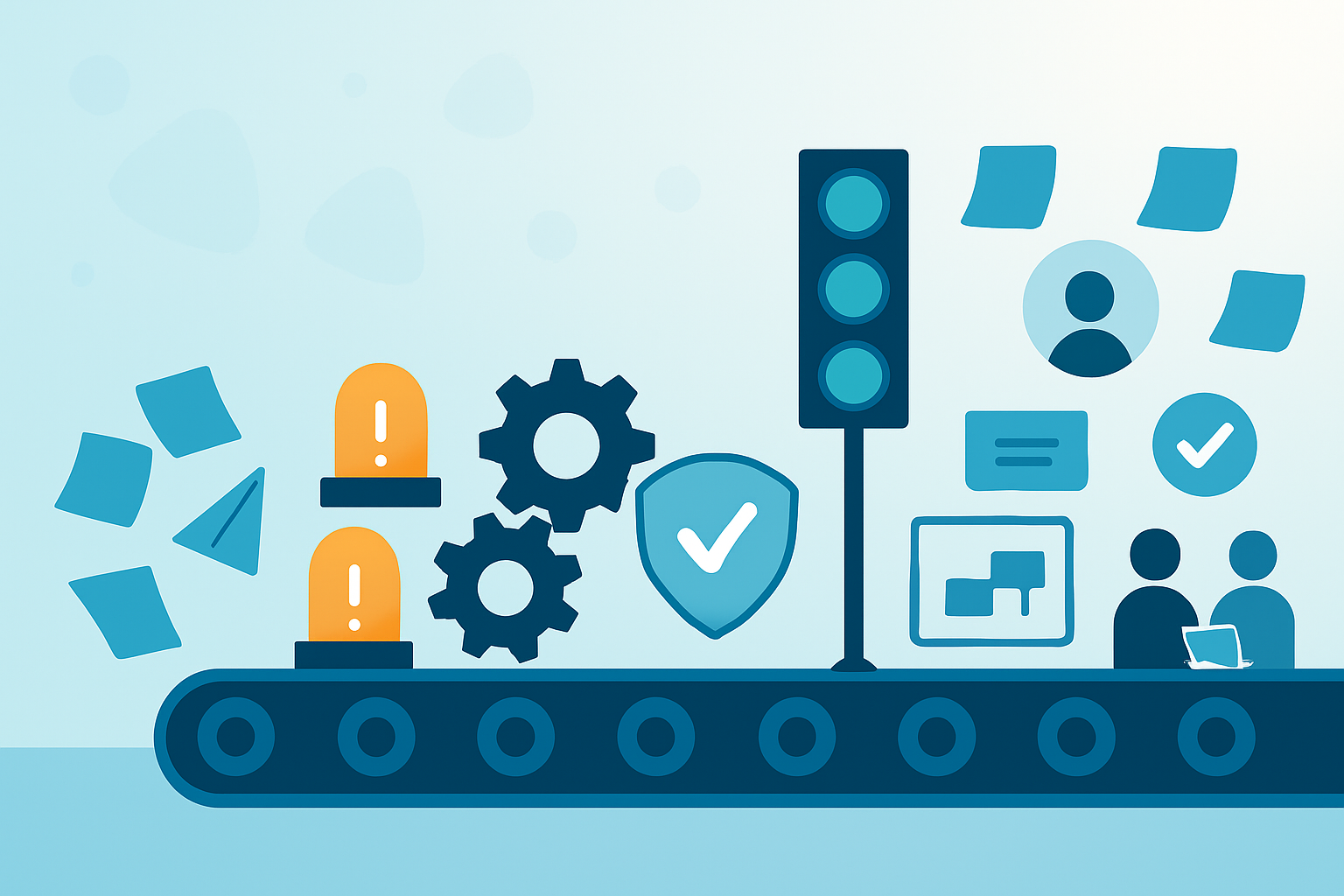
But instead of putting simple guardrails in place, projects get put on hold while people wait for perfect answers.
The result is often no progress at all.
There's also a skills gap. From the outside, AI can sound plug-and-play, but in reality it still requires people who understand how to manage it, monitor it, and step in when something doesn't look right.
Most organizations aren't lacking ambition; they're lacking confidence.
Interestingly, businesses already understand that AI won't be fully hands-off any time soon.
Most AI decisions today are still reviewed by humans, and many leaders expect a long-term balance where people and AI share responsibility rather than one replacing the other.
That's a sensible place to start. So how do you stop AI initiatives from stalling?
The businesses making real progress usually do three things well.
First, they connect AI to a specific, practical business outcome.
Saving time in IT operations, improving system monitoring, speeding up reporting. Not huge transformation, but measurable improvement.
Second, they define clear boundaries.
What can AI do on its own?
What always needs a human review?
That clarity reduces fear and helps decisions happen faster.
And finally, they scale slowly and deliberately.
Instead of spending money on multiple tools and hoping one sticks, they prove value in one area, learn from it, and then expand.
AI doesn't usually fail because it's too advanced.
It fails because it's too vague.
If your AI projects feel stuck, the answer is clearer goals, better guardrails, and a willingness to move forward imperfectly, with humans firmly kept in the loop.
If you're exploring AI but finding it hard to move forward, my team and I can help. Get in touch.
Click Here or give us a call at 714-369-8197 to Book a FREE 15-Minute Discovery Call